How Magazine Demo Discs Shaped PS1 and Saturn Habits
This magazine demo discs explained essay covers how 1990s cover discs on PlayStation and Saturn shaped buying habits, from timed demos to region locks.
Before broadband, the fastest way to try a new PlayStation or Saturn game was to buy a magazine and put the cover disc into your console. That disc was the discovery channel of the 32-bit era: a cheap optical disc holding a menu, a few playable slices and some video clips. It worked because pressing a CD cost so little that publishers could give it away, and because there was no other way to see a game in motion before paying. The habit it created, judging a purchase from a few minutes of play, outlasted the discs. Here is how the mechanism shaped what people bought.
Why optical media made cover discs possible
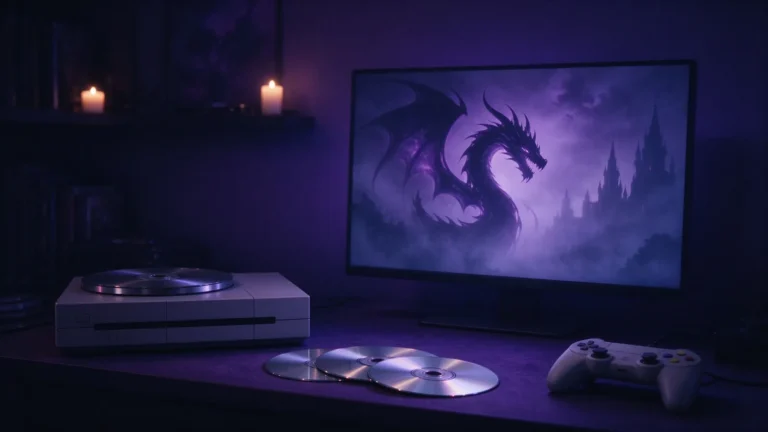
Cartridges were expensive to make and slow to duplicate, so giving one away with a magazine made no economic sense. The move to optical discs in the mid 1990s changed that. A CD-ROM held far more data than a cartridge and cost a fraction as much to press in volume, which let a publisher treat a sampler as a marketing expense rather than a product. Both the PlayStation and the Sega Saturn read standard compact discs, so one disc carried a bootable program, video and audio together. Once a magazine could afford to bind a disc to its cover, a monthly sampler became routine. The disc could also be mailed, shelved and lent with no hardware beyond the console you already owned.
What was actually on a demo disc
Open one and you usually met a menu shell first, a small boot program listing the contents. From there you picked a playable demo or a video clip. The playable slice was typically timed, expiring after a few minutes, or a single truncated level rather than the game’s opening. Video clips were pre-rendered footage showing the game at its best. Some discs bundled extras like save files, but the core was a sampler: several genres in one place, each given a short slot. The menu shell mattered because it framed the whole thing as a curated shelf rather than a pile of files.
| On the disc | What it was | Effect on a buying decision |
|---|---|---|
| Boot menu shell | a simple list of demos and clips | framed the disc as a curated sampler |
| Timed playable demo | a slice that expired after a few minutes | let you test controls before paying |
| Video clip or trailer | pre-rendered footage on the disc | sold the look, not the feel |
| Truncated level | one section of a stage, often not the opening | gave a distorted first impression |
Region locking and the boot menu
Cover discs were region-locked in the same way retail software was. A disc pressed for one territory would not boot on a console from another, so a PAL disc was useless on an NTSC machine and the reverse. That was distribution control, not a technical limit of the demo, and it is why a disc lent among friends stayed within one region. It also explains why publishers were comfortable shipping near-final code on a giveaway: the timed slice and the boot menu kept the experience bounded, and the lock stopped the disc becoming a free full game elsewhere. These were commercial products with territory rules, not neutral samples.
How demos changed buying habits
The practical effect was that readers sampled before committing. A full-price game was a significant purchase in the late 1990s, and a playable demo answered the two questions a screenshot could not: does this genre suit me, and can I work the controls. You could learn a control scheme in a few minutes, decide a racing game felt wrong, and move on without spending anything. Discs were shared with friends, so one copy reached a whole group. This is the mechanism worth naming: the cover disc was a low-cost filter that reduced the risk of a blind buy, shifting some power toward the player when reviews and box art were the only other signals. Publishers accepted it because a good slice sold more than an advertisement could.
Where the first impression misled you
The same format distorted what you saw. A demo was a marketing build, not final code, so performance, balance and features could differ from the retail release. Load times on an optical console were long, and a truncated level often started mid-stage with no tutorial, making a game feel more confusing or more impressive than it was. A timed slice rewarded spectacle over depth, so demos tended to show the loudest part of a game. The disc was an honest test of controls but a poor test of a whole game. It is easy to dismiss a title on a sampler and enjoy the retail version months later, which is exactly the failure mode this setup invites.
A habit that outlived the discs
My view is that the format trained people to judge a game by a short slice, and that habit survived the cover disc. Once broadband arrived, downloadable demos and then trailers took the same job, still asking you to decide from minutes a marketing team chose. The convenience and the risk reduction were real, but the frame never became neutral. A demo shows how a game wants to be seen, not how it plays over ten hours. The cover disc deserves credit for making try-before-you-buy normal, and blame for making first impressions feel like verdicts. Both hold without naming a single magazine issue.
Checking it yourself
To verify any of this, find a preserved cover disc and the retail release of a game that appeared on it, then compare them side by side. Note where the demo’s level layout, load times or difficulty differ from the finished product, and ask which impression the sampler was built to leave. A general claim about the era is easy to make and easy to check; the specific part, that a demo is a build rather than the game, shows up the moment you look at two versions of one title. That comparison is the argument in miniature.
Related reading
If you want to keep digging into this corner of the library, these two posts on Roms Get go a little further: