Why Random Encounters Shaped 16-bit RPG Pacing

Step-based random encounters set the rhythm of 16-bit RPGs by draining HP and MP between save points, and that pacing still shapes a modern replay.
Final Fantasy VI on the SNES rolls for a fight every few steps in the caves around Narshe, and that one table governs how far you are willing to walk from a save point. Random encounters were not simply a limitation of 16-bit hardware. They were the metronome of the genre, doling out combat, draining resources and deciding how long a dungeon felt. I replayed four of these cartridges over a weekend using legal backups of media I own, and the thing that surprised me was not the graphics but the rhythm: the same corridor feels twice as long when a battle can start on any step. This is a look at how that step-driven pacing worked, where designers removed it, and what the trade cost.
Step counters and the shape of a dungeon
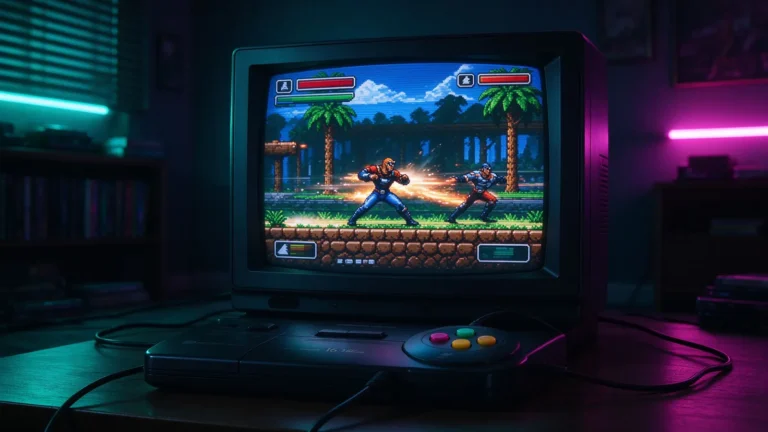
Most 16-bit RPGs did not spawn enemies at random in the literal sense. They counted steps. A hidden counter advanced as the party moved across a field or dungeon tile, and once it crossed a threshold drawn from a terrain table, the game rolled for an encounter and reset the counter. World map, forest, cave and interior each carried their own rate, which is why the first screen of a forest feels safe and the third one does not. Final Fantasy IV on the SNES in 1991 made this legible by pairing the field with Active Time Battle: the interrupt dropped you into a screen where an ATB gauge filled in real time, so a random fight also imported time pressure into a turn-based system. Dragon Warrior on the NES in 1989 had already established the simpler version, one enemy at a time and short enough that a fight rarely cost more than a minute. The 16-bit consoles inherited that loop and stretched it, adding party members, rows, espers and MP pools that made each interrupt more expensive.
How ATB and MP turned interrupts into a resource clock
Final Fantasy VI, released in 1994 as Final Fantasy III in North America, is the clearest case. Its espers teach magic slowly, so MP is scarce early, and dungeons such as the mines outside Narshe place a save point near the entrance and a boss at the far end. The walk between them is a series of rolls. I timed a run without fast-forward and found myself retreating to heal after roughly the same number of fights each attempt, which is exactly the push-your-luck loop the step counter was built to produce. Active Time Battle from Final Fantasy IV mattered here too, because a full ATB gauge keeps ticking while you read a menu, so even a trivial random fight punishes hesitation. The interrupt was never only about adding combat; it was about making the whole party’s upkeep a persistent low hum.
Where visible enemies changed the deal
The counter-movement is easy to name because a handful of SNES cartridges removed the step roll entirely. A table makes the comparison concrete.
| Game | Year | Encounter model | Effect on pacing |
|---|---|---|---|
| Final Fantasy IV | 1991 | Random, step based, ATB | Real-time gauge makes each interrupt a timed fight |
| Final Fantasy VI | 1994 | Random, high dungeon rate | Attrition between save points decides when to retreat |
| Secret of Mana | 1993 | None, enemies on screen | You choose each fight and a charge meter gates attacks |
| Chrono Trigger | 1995 | Visible, battles on the field | No screen transition, combos, exploration stays fluid |
| EarthBound | 1994 | Visible, instant wins on weak foes | Low-level enemies stop costing any time at all |
| Phantasy Star IV | 1993 | Random, first person, macros | Repeat fights resolve fast but still drain the budget |
Chrono Trigger in 1995 is the sharpest contrast. Enemies stand on the map, battles unfold on the same screen without a transition, and two or three party members can chain combo techs. Because you can walk around most encounters, the dungeon stops being a gauntlet and becomes a space you cross on purpose. EarthBound, released in Japan in 1994 as Mother 2, went further: touch a much weaker enemy from behind and the game simply awards the win with no battle at all. Secret of Mana in 1993 replaced the roll with a real-time action system where a percentage meter refills after every swing, so waiting for it to reach full power became its own little pacing tax. None of these games removed friction; they moved it somewhere else.
The case against random encounters
The complaint is old and it is fair. Step-based fights interrupt navigation, and on a first playthrough they punish curiosity: checking a dead-end corridor can cost three battles and the MP you were saving for a boss. They also inflate playtime. A modern emulator with a fast-forward key or an encounter-rate option can cut that padding dramatically, and I will not pretend I never reach for it on a third replay. But there is a real loss when the roll disappears. Without the chance of an interrupt, the decision to keep exploring carries no price, and the save point near a dungeon entrance stops mattering as a landmark. Secret of Mana is freer to wander than Final Fantasy VI, and I like it for that, yet it never recreates the specific small relief of reaching an inn with two HP and one ether left. That feeling was manufactured by a random number generator, and it worked.
What to try on the next replay
If you want to feel the mechanism instead of remembering it, pick one dungeon and play it once with whatever encounter-reducing option you normally use, then once with none, and note the exact step where you first turn back toward the entrance. Keep everything else identical: same party levels, same save point, same legal backup of a cartridge you own. The number you write down is the encounter rate doing its job, and it is a more interesting measure of a 16-bit RPG’s pacing than any boss tier list. I keep a paper note of that turn-back point for each cartridge now, and it changes how I read the whole back half of Final Fantasy VI.
Related reading
If you want to keep digging into this corner of the library, these two posts on Roms Get go a little further: