Soukoban
| Release Date | 1985 |
| Type | Fan Translation |
| Publisher | SEGA Enterprises |
| Developer | Thinking Rabbit |
| Region | Japan, Korea |
 Sega Sokoban (倉庫番) Full Introduction
1. Basic Release Information
Released by SEGA in 1985, Soukoban (known worldwide as Sokoban) was published as a SEGA MY CARD game cartridge. Compatible hardware platforms include:
- SC-3000 home computer
- SG-1000 series original console
- SEGA Mark III (predecessor to the Sega Master System / SMS)
This is a single-player title. The original Sokoban creator studio Thinking Rabbit developed the core game, while SEGA handled porting and distribution for its home systems.
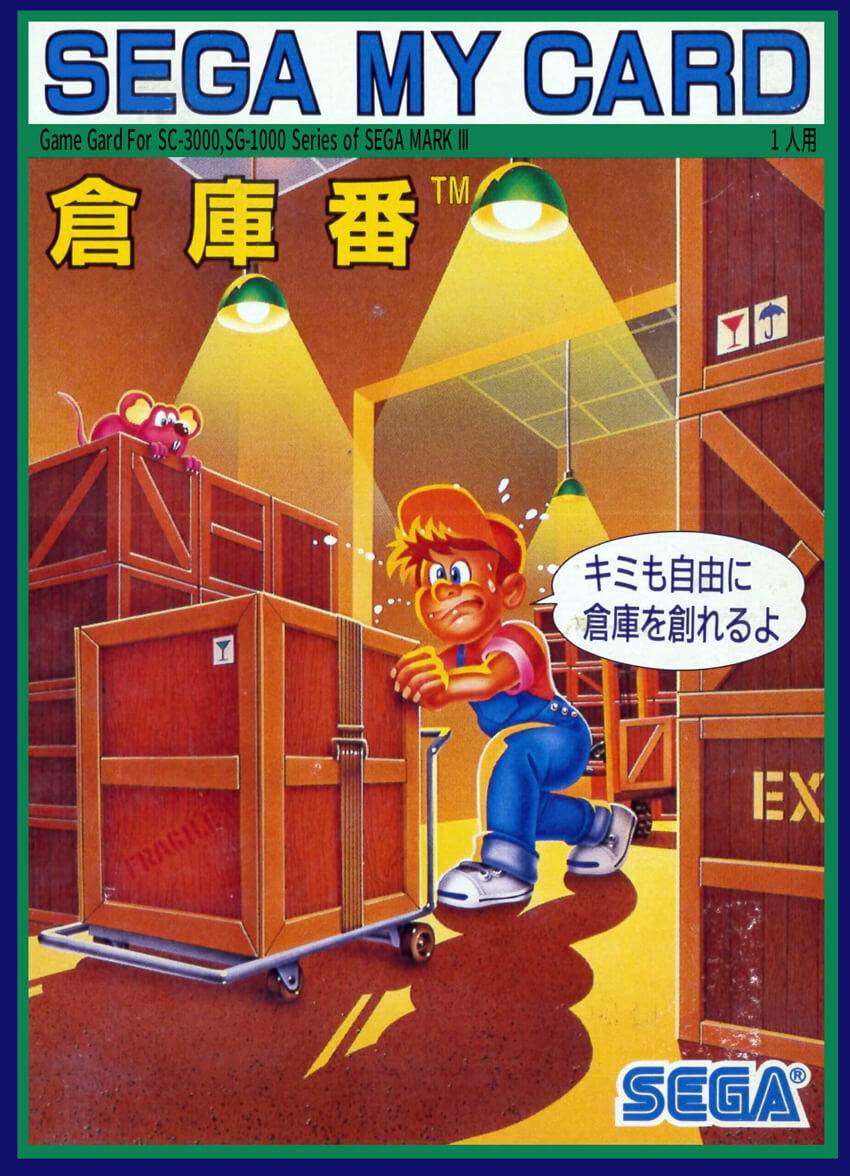
The Japanese line on the box art — キミも自由に倉庫を創れるよ — translates to “You can freely create your own warehouse stages”, referencing the game’s standout feature: a built-in level editor.
2. Game Core: Classic Sokoban Ruleset
Sokoban (literally “warehouse keeper”) is the original template for all box-pushing puzzle games globally. It first launched on Japanese personal computers in 1982, and this SEGA port is an official, faithful early home console adaptation with identical core gameplay rules:
- You control a warehouse worker character; you can only push crates, never pull them. Only one crate can be pushed at a time — you cannot shift two side-by-side crates simultaneously.
- Win condition: Slide every wooden crate onto its marked target spot to clear the stage.
- Game over trap: If a crate gets wedged into a corner or two crates block each other with no way out, the puzzle becomes unsolvable. You must restart the level. Hard stages require planning dozens of moves in advance to avoid dead ends.
3. Exclusive Feature: Built-In Level Editor (The Box Slogan Highlight)
A Rare Feature for 1980s Home Consoles
This level creation tool is the biggest unique selling point of the SG-1000 version of Sokoban:
- Editor mode lets you place walls, player spawn points, wooden crates and target markers to design fully original custom Sokoban puzzles.
- You can also modify the official pre-made levels included with the game to tweak their difficulty.
Key Limitation
Console hardware of this era lacked persistent storage. Custom-made stages cannot be saved; all player-created maps are erased once the system powers off, and can only be played during the same session you built them in.
4. Game Content & Difficulty Design
- Included Original Stages: The game ports the classic puzzles from the original 1982 PC release, with a smooth difficulty curve. Early levels serve as simple tutorials, while later mazes feature tight corridors and large numbers of crates with very little room for error.
- Scoring System: Points are calculated based on the total number of moves taken to finish a level. Fewer moves equal a higher score, encouraging repeated play to optimize your solution path.
- Theme & Easter Egg: The game takes place inside a warehouse. The mouse character shown on the box art appears as an interactive obstacle in several levels, shifting positions to block your movement paths.
5. Historical Significance
- This is SEGA’s first official home console release of Sokoban. Later SEGA platforms including the Game Gear handheld and Mega Drive (Genesis) received follow-up Sokoban titles.
- Its integrated level editor was highly uncommon for 1980s console games, and set a precedent for custom puzzle creation modes adopted by many similar puzzle games that followed.
- The core Sokoban puzzle design remains timeless, replicated in countless mobile games, browser mini-games and indie titles across decades, cementing its status as one of the world’s most widely recognized puzzle game templates.
Soukoban download
| Filename | Type | file extension | Size |
|---|---|---|---|
| Soukoban (Japan) (T-En by Maurice Kaltofen v1.0) | Fan Translation | .sg | 18.7 K |