The 15 Best Nintendo DS Games Every Retro Fan Should Try: Classics and Hidden Gems
Selling well over 150 million units across its many revisions, the Nintendo DS had a huge library split between mainstream hits and weird little experiments nobody expected. These are the fifteen worth chasing down.
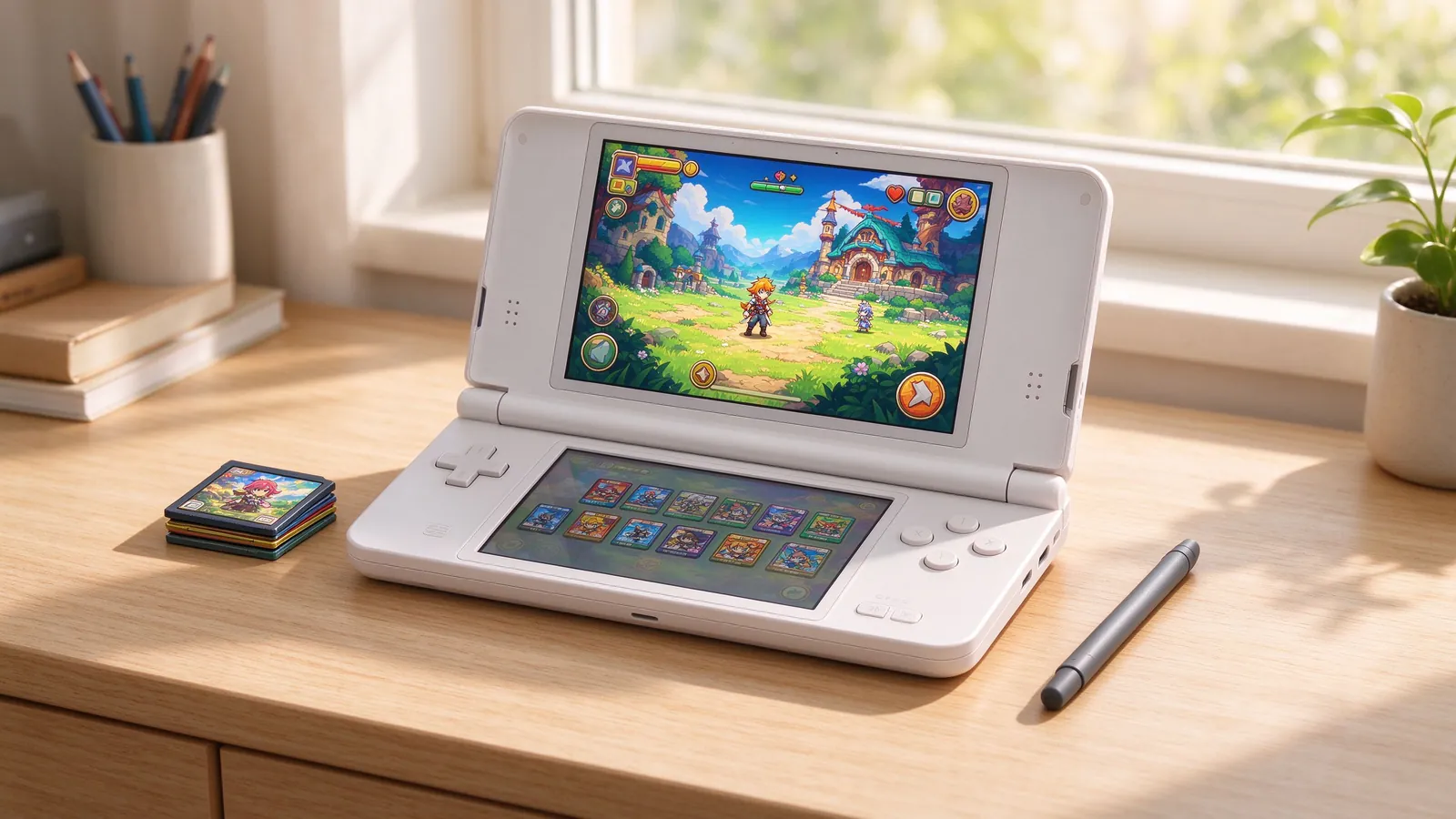
The Nintendo DS launched in late 2004 with two stacked screens, a touch stylus, and speakers loud enough to annoy anyone sitting next to you on a bus. On paper it sounded like a gimmick; in practice the extra screen and touch input shaped games in ways normal handhelds never did. Map screens on the bottom, menus you could tap, rhythm games you could strum, and a whole wave of brain-training software that pulled in non-gamers. More than twenty years later, the best DS games still run beautifully on emulators, and many are hard to find cheaply in cartridge form.
This list splits into two halves: eight must-play classics that define the system, and seven hidden gems that deserve more attention than they usually get. Play order does not matter; pick whatever matches your mood.
The must-play classics
1. Mario Kart DS (2005). The handheld entry that cemented the series’ local multiplayer reputation. Retro tracks from earlier Mario Kart games, tight drift handling, and online play that felt revolutionary on a 2005 handheld. It still plays like a party game you can start in thirty seconds.
2. New Super Mario Bros. (2006). The return of 2D Mario after a long stretch of 3D-only entries. Chunky visuals, the blue Koopa shell power-up, and plenty of secret exits. Short levels made it perfect for bus rides, and it sold like nothing else on the platform.
3. The Legend of Zelda: Phantom Hourglass (2007). A direct sequel to Wind Waker built around the touchscreen: you draw paths, solve puzzles by tapping, and sketch route lines on the map itself. The repeating dungeon divides fans, but the overworld exploration and art style remain charming.
4. Pokemon Diamond / Pearl (2006–2007). The fourth generation of Pokemon, with Wi-Fi trading, online battles, and a Sinnoh region that fans still argue about. Even if the pacing feels slow by modern standards, the roster and post-game content kept players occupied for hundreds of hours.
5. Animal Crossing: Wild World (2005). Life simulation on the go: fishing, bug catching, decorating a house, and visiting friends’ towns over local wireless. The real-time clock made every day feel slightly different, and it remains one of the coziest games in the catalog.
6. Mario & Luigi: Bowser’s Inside Story (2009). The peak of the Mario RPG spin-off series. Clever writing, simultaneous Mario and Luigi action on both screens, and Bowser as an unexpectedly sympathetic co-lead. The turn-based timing mechanics are easy to learn and hard to master.
7. Chrono Trigger (DS port, 2008). The SNES classic rebuilt for the dual screens with added side quests and a translated ending arc. If you missed the original, this portable version is one of the most comfortable ways to play it, and the time-travel story still ranks among the best in JRPG history.
8. Castlevania: Dawn of Sorrow (2005). A direct follow-up to Aria of Sorrow on the GBA, with soul-collecting abilities and a touchscreen sealing mechanic for bosses. The music, sprite work, and exploration flow make it a top-tier Metroidvania on the platform.
The hidden gems
9. The World Ends with You (2007). Stylish Tokyo street fashion, a story about survival in an afterlife game, and a battle system spread across both screens that nobody else copied. It was built specifically for the DS hardware, which means it feels oddly unique even today.
10. Advance Wars: Dual Strike (2005). Turn-based tactical warfare with charming maps, unit counters, and two-screen battles where you manage ground and air forces together. Easy to understand, brutal to master, and perfect for slow evenings.
11. Grand Theft Auto: Chinatown Wars (2009). A top-down GTA with surprisingly deep systems, drug-dealing side mechanics, and touchscreen minigames for hotwiring and spray painting. It was far more ambitious than most people expected from a handheld GTA.
12. Hotel Dusk: Room 215 (2007). A noir detective story told through a tilted handheld, with pencil-sketch visuals and conversations that branch naturally. Slow, moody, and completely unlike anything else in the library.
13. Radiant Historia (2010). A time-traveling tactical RPG with branching timelines and a grid-based battle system that rewards positioning. The script is tight, the soundtrack is excellent, and it never gets the mainstream love it deserves.
14. Kirby: Canvas Curse (2005). No buttons for movement: you draw ramps and loops on the touchscreen to roll Kirby around. It sounds simple, but the level design and the creative power-ups make it one of the most original Kirby games ever made.
15. Trauma Center: Under the Knife (2005). Surgical operations played with the stylus: stitch wounds, drain blood, defibrillate patients under a timer. The difficulty spikes hard, but the arcade pressure and the medical drama make it unforgettable.
Playing DS games on a phone or PC
Modern emulators handle the dual-screen layout well. melonDS is the main free option on Windows, macOS, and Linux, and it supports save states, upscaling, and controller mapping. On Android, several builds let you keep a library on the phone for commute play; on iOS, check the current app store situation, since emulator availability shifts from time to time. For PSP fans, PPSSPP covers the next handheld generation once you finish the DS backlog.
Quick tips for a smoother DS emulation session
Keep the two screens stacked vertically rather than stretched side by side, since many puzzles assume the original layout. Map the stylus to your mouse or a touch-enabled display; games like Trauma Center and Canvas Curse suffer when every input has to be clicked precisely. Save states are great for tough boss fights, but use the in-game save before closing, since state compatibility can break between emulator versions. Finally, watch out for microphone-dependent minigames; most emulators let you feed a noise sample or a key press in place of a real mic.
The DS library rewards curiosity. Start with the classics, let a hidden gem surprise you, and do not judge a cartridge by its tiny size — some of the longest and most creative games of the era live on those little cards.