How Backlit Screens Changed Where We Play Handheld Games
How backlit handheld screens changed the places we play: reflected LCDs, the Game Boy Advance family, early DS models and the trade between washout and glow.
Before backlit handheld screens, playing a game outdoors meant finding the light and aiming the screen at it. The original Game Boy Advance had no lamp of its own, so a session depended on where the window was, whether a desk lamp was close enough, and how you held the unit to keep a dark stripe of your own reflection off the glass. That physical ritual shaped where games happened.
Backlighting removed the ritual. It also changed color contrast, battery life and the kind of place a portable session could be. Both effects are worth separating, because the first was an aesthetic gain and the second a practical one.
Reflected light and the geography of play
A reflective LCD does not produce light; it borrows it. In a bright room that is efficient, and you get a crisp image with no power spent on illumination. In a dim room the same screen goes grey and the colors collapse into mud. So you moved. You played by a window at midday, under a kitchen lamp in the evening, and not at all in a car at night unless someone else was driving with the interior light on.
This is the part that is hard to explain to someone who started with a lit panel. The screen was not simply worse; it was conditional. Good play depended on a negotiation with the room, and the player became good at reading a space for usable light.
Frontlighting as the middle step
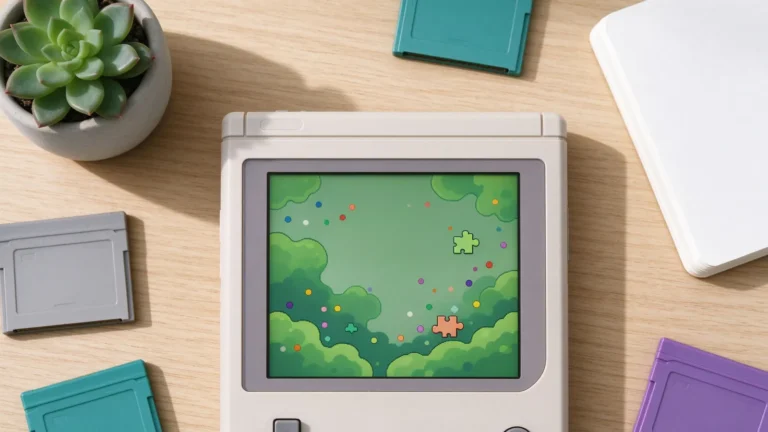
The Game Boy Advance family is the cleanest example of the transition. The original model used reflected light. A later folding revision added a frontlight, which shines across the front of the display rather than from behind it, so the borrowed light still does most of the work but the panel stays readable when the room dims. A subsequent revision of the same family used a true backlight, and the difference in color was immediately obvious.
Frontlighting was a compromise. It rescued dim rooms without draining the battery as fast, but bright light could wash the image out, and the added layer sometimes made blacks look silvery. I remember thinking the early folding model was the best of both worlds until I saw a backlit screen next to it.
What each lighting method changes
| Method | Strength | Cost |
|---|---|---|
| Reflected LCD | Sharp in bright light, no lamp power | Unreadable in the dark, prone to glare |
| Frontlit LCD | Usable indoors, modest power draw | Washout in sunlight, silvery blacks |
| Backlit LCD | Consistent contrast, richer color | Higher battery drain, glow in a dark room |
Early Nintendo DS models belong in the same story, with a lit panel that made their color work readable in places a reflective screen would have failed. The shift was not one invention but a gradual move from borrowing light to carrying it.
Frontlighting depends on ambient light arriving from the front, so a bright window can both help and hurt: it feeds the light layer while also bouncing off the glass. Backlighting removes that dependency, which is why the picture becomes more predictable but also less tied to the room. Predictability is exactly what a commuter wants and exactly what a purist might miss.
Battery life was the real price
Lighting a panel from behind costs power, and on early hardware that cost was easy to feel. A player who once got a long session from a charge or a set of cells now watched the indicator more carefully. The trade was rarely stated as a single decision, because manufacturers balanced panel size, brightness settings and battery together, but the result was plain: brighter screens meant more frequent charging.
That is why the compromise between washout and glow mattered. A dimmer backlight stretched a session and still beat a reflective screen in a dark room. A brighter one looked excellent at a desk and emptied the battery on a night journey.
Where play moved after the light stayed on
- Under bed covers at night, where a reflective screen was useless.
- On evening journeys, where a fixed lamp was not available.
- At a desk in a bright office, where glare became the problem instead of darkness.
- In shared rooms, where the player no longer had to claim the seat nearest the window.
Each of these is small on its own. Together they describe a real change in the geography of a hobby. Portability stopped being about where you could carry the device and started being about where you could see it.
What an emulator cannot reproduce
A modern emulator can show the same pixels on almost any display, and it can add effects that imitate an old panel. What it cannot copy is the act of finding light in a room. The tilt of the wrist, the move to the window, the decision to stop because the sun went behind a cloud: those were part of the game session, and they are gone once a screen lights itself.
That is not an argument against backlighting. I would not trade the ability to play in the dark for the old ritual. It is a note about what was lost, and about why backlit handheld screens changed more than picture quality. They changed the player relationship to the space around the device.
A practical way to feel the difference
If you own both an early reflected handheld and a later lit one, put them side by side near a window and then turn the lamp off. The comparison takes a minute and explains the whole transition better than any specification. The older screen will look cleaner in daylight and die in the dark. The newer one will look slightly soft by the window and stay readable everywhere else. That small experiment is the clearest record of what backlit handheld screens actually did.
Related reading
If you want to keep digging into this corner of the library, these two posts on Roms Get go a little further: