Silent Hill on PS1 Revisited: Fog, Radio and Otherworld
Silent Hill PS1 revisited: fog, a static radio and an Otherworld school make this 1996 Konami horror game far more unsettling than its tank-controlled fights.
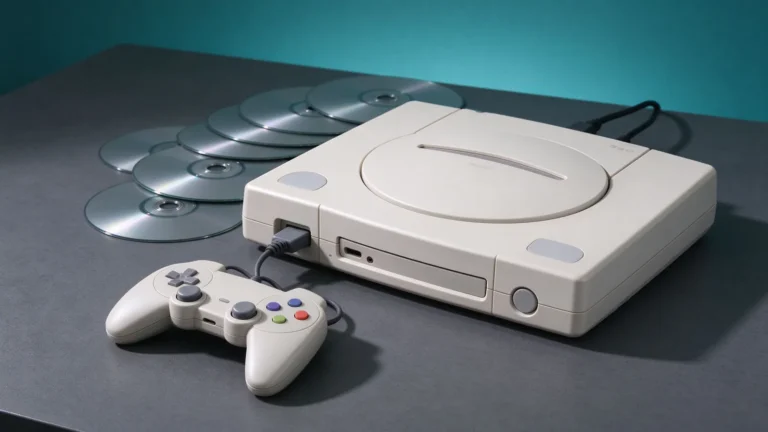
Silent Hill arrives on the PlayStation in 1996 from Konami and reaches North America in 1997, and almost nothing about it looks like its horror contemporaries. Where other games put a weapon in your hands first, this one gives Harry Mason a flashlight, a town map and a radio that crackles when something is close. Harry is looking for his adopted daughter Cheryl, who has vanished in a fog-bound town, and the search unfolds through places that change shape without warning. Revisiting it, the scariest part is still how little the game explains.
Fog is a design tool, not a mood
The fog is the first thing you notice and the last thing you stop noticing. It hides the edges of the map, cuts the draw distance to a few metres and makes every streetlight a landmark. That is not decoration. Limited visibility turns a simple walk into a decision about which direction to trust, and it lets the game reuse a small set of streets without showing you the seams. When the mist clears for a moment, it feels like something has been revealed rather than rendered.
The same trick applies indoors. Corridors end in darkness, rooms are darker than the halls between them, and the flashlight becomes a way of spending attention. You sweep it across a wall, catch a shape and second-guess what you saw. On an emulator the effect is easier to study, because a clean output makes the layering obvious: the fog is a deliberate veil, not a compromise the hardware forced.
The flashlight, the map and the static radio
Three tools carry almost all of the tension, and none of them is a gun:
- Flashlight lights a narrow cone ahead of Harry and drains nothing, so the cost is simply what you fail to see at the edges.
- Town map marks streets that exist only while you walk them, which makes it feel unreliable in a way a finished atlas never would.
- Static radio hisses louder as something nears, giving you a warning that arrives before any visual confirmation.
The radio is the cleverest of the three. It does not point at the threat or name it; it only says that the space around you has changed. I found myself stopping in a corridor and waiting for the noise to settle before turning a corner, which is a strange thing to do with a controller in your hand. That pause is the game working as intended.
School, hospital and the Otherworld
The town is not one continuous place so much as a set of locations you unlock by finding keys and following clues. Three of them stand out, and each has an ordinary face and a shifted one:
| Location | Ordinary layer | Shifted layer |
|---|---|---|
| School | Classrooms and corridors | Rusted grids and a hidden basement |
| Hospital | Wards and a reception area | Twisting halls with missing walls |
| Lighthouse | A sealed tower above the town | The route below it changes character |
The shift into an Otherworld is the game’s defining image. Rust spreads over tile, geometry becomes wrong in small ways and the light turns harsh. What makes it effective is the lack of a rule. You never learn exactly when a place will flip, so the next doorway is always a question. Replaying it, I noticed that the shifted spaces are not randomly weird; they echo the ordinary layout, which keeps you oriented just enough to keep moving.
Tank movement and its cost
Harry moves with the tank controls typical of the era. Push up and he walks forward relative to his own facing, not the camera, and turning takes a moment. In a corridor this is fine. In a tight room with something between you and the door, it becomes a small puzzle of its own. Modern players often call this awkward, and they are right, but the awkwardness also slows you down at exactly the moment you want to rush. The game gets tension from a control scheme that refuses to be quick.
Camera angles cause the other complaints. Fixed views can place a wall between you and a threat, or hide a pickup behind a foreground object. You learn to nudge Harry a step and wait for the view to catch up. That is a ritual, not a bug, and once accepted it becomes part of how you read a room.
Sound does more than the pictures
The soundtrack is built from industrial noise, distant metal and long stretches of near silence. Footsteps on different floors tell you what surface you are on before you look down. The radio hiss sits underneath everything, so the moment it cuts out is as loud as any sting. I play this one with speakers rather than headphones, because the low frequencies give the fog a weight that a small driver loses.
Silence is used with similar discipline. A room can be quiet for thirty seconds, then break with one sound from out of frame. There is rarely a cue that says an event is coming, which is why the sound design still holds up. It rewards attention instead of demanding a reaction.
Why uncertainty beats a firefight
The combat is the part that has aged worst. Harry swings a pipe with a wind-up, enemies soak more damage than they look capable of, and the fixed camera makes it hard to keep track of more than one attacker. The game gives you ammunition and then makes spending it feel wasteful, which is a reasonable way to keep the player uneasy but a poor way to make a fight satisfying.
Uncertainty works better here because the game never lets you confirm what you are facing. Once you can see a threat clearly and kill it, the fog becomes a backdrop. The strong sections are the ones where you choose to walk away, where the radio crackles and you decide that being late is better than being sure. Silent Hill PS1 revisited is worth your time for that decision, not for the pipe. Try a late run with the lights off and the map in view, and notice how often you stop before you have to.
Related reading
If you want to keep digging into this corner of the library, these two posts on Roms Get go a little further: