Ninja Princess
Sega’s classic Run&Gun retro game, first released in 1985, was named Sega Ninja in Europe and America. In 1986, it was released as a home cartridge version (SEGA MY CARD specification) of SG-1000/SEGA Mark III (first generation Master System).
|
Release Date
|
1986 |
| Type | Fan Translation |
|
Publisher
|
SEGA Enterprises |
| Developer | Sega Enterprises |
| Region | Asia |
Ninja Princess (also known as Sega Ninja) Game Full Introduction
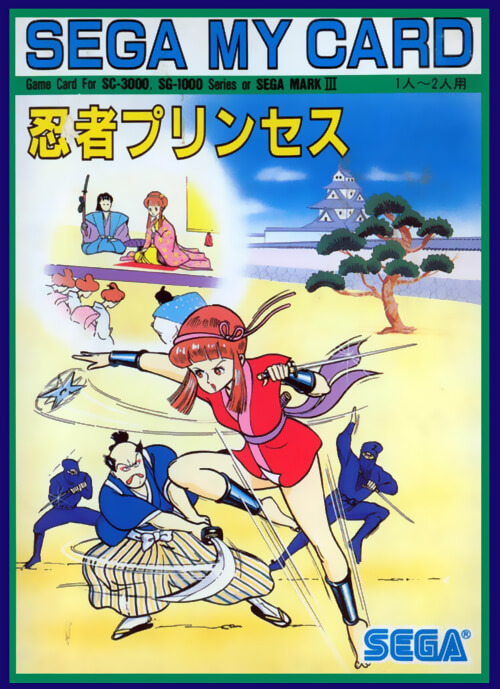
This classic Japanese run-and-gun game was developed and published by SEGA. The picture shows the physical SEGA MY CARD version released for SG-1000 and SEGA Mark III home consoles in 1986.
1. Release Information
- Original launch: Arcade cabinet (SEGA System 1 hardware) released in 1985
- Home console ports: Ported to SG-1000, SEGA Mark III (Master System overseas) and MSX in 1986. It has been re-released multiple times via game collections and Sega Saturn compilations later.
- Player mode: Single-player main mode, supports 1-2 players taking turns to play
- Historical background: One of the earliest Japanese-style ninja scrolling shooting games in the 1980s, debuting earlier than iconic run-and-gun titles like Cabal.
2. Game Plot
The protagonist is Princess Kurumi. Her residence, Kanten Castle, is seized in a rebellion by the treacherous retainer Zaemon Gyokuro, who kidnaps the princess. After escaping captivity, Kurumi disguises herself as a female ninja (kunoichi). She fights her way through hordes of enemy ninjas and samurai to defeat the traitor and take back her family castle.
The box art perfectly matches the game’s story: the red-cloaked ninja princess battles hostile samurai surrounded by enemy ninjas, with classic Japanese pine trees and a feudal castle in the background to highlight traditional East Asian aesthetics. The noble lady drawn in the upper-left corner represents Kurumi’s true royal identity.
3. Core Gameplay
Combat Basics
The game features an isometric top-down perspective. Players move in 8 directions and throw unlimited shurikens and throwing knives. Collectible power-ups upgrade regular shurikens into giant projectiles with vastly larger hit ranges. Hostile units include black-cloaked ninjas, swordsmen, archers and ronin that swarm players from all directions.
Ninja Stealth Invisibility Skill
Players can cast a short-duration invisibility jutsu to become completely invincible to all enemy attacks.
- Arcade version: Dedicated button to activate stealth.
- SG-1000 home version: Due to limited controller buttons, invisibility is triggered by pressing two function buttons simultaneously.
Stage Design
The original arcade version has a total of 16 looping stages; players restart the whole campaign with increased difficulty after beating all levels. Level types are diverse:
- Open field maps: Countryside farmlands, forests and riverbanks with free directional movement
- Auto-scrolling stages: Dodge boulders and stampeding horses while running forward
- Vertical wall-climbing levels: Scale castle walls upward while eliminating defending foes
- A boss must be defeated at the end of every stage to progress
The SG-1000 port cuts some unique levels to fit hardware limitations, but retains all core gameplay loops.
4. Differences Between Major Versions
| Game Version | Key Features |
|---|---|
| Original Arcade | Full visuals, complete level roster, full button layout, intact visual effects, higher overall difficulty |
| SG-1000 (card version shown) | Downgraded graphics, trimmed levels, dual-button invisibility, adapted for early 8-bit home console hardware |
| Mark III / Master System | Smoother graphics and performance than SG-1000, much closer to the arcade experience |
| Western Release Sega Ninja | Renamed title, slightly altered enemy color schemes, simplified localized plot |
5. Retro Gaming Legacy
- It pioneered feudal Japan-themed ninja run-and-gun gameplay, blending melee ninja aesthetics with shooter mechanics for a highly original design.
- It was one of the few major 1980s action-shooter games with a female lead character, cementing Princess Kurumi as a classic early video game heroine.
- The vintage hand-drawn box art carries strong retro charm. Physical authentic game cartridges remain high-value collectibles among retro game hobbyists today.
| Filename | Type | Size |
|---|---|---|
| Ninja Princess (Japan) (T-En by Goldenband v1.0) | Fan Translation | 19.77 K |