How Link Cables Turned Game Boy Into a Social Console
Game Boy link cable culture grew from a serial port, turning Tetris battles, Pokemon trades and four-player sessions into rituals you shared in person.
The Game Boy that launched in 1989 had a serial port on its side, and that small socket changed what the machine was for. Before online matchmaking, two players had to sit near each other with a cable running between their handhelds. That physical requirement created a set of habits around waiting, trading and showing off that a single-player cartridge could never produce. Game Boy link cable culture was built on the simple fact that a game could be something you did together, in person, with a wire you had to remember to bring.
Tetris and the first competitive link
Tetris was the clearest early demonstration of what the link cable could do. In two-player mode, clearing lines sent garbage blocks to the other player’s well, which turned a solitary puzzle into a contest of speed and pressure. The rules were easy to grasp and hard to master, and the cable made the stakes immediate. You could see your opponent’s stack rising in real time on their screen, which is a very different experience from playing against a computer.
That immediacy mattered. The person across from you could taunt, watch your mistakes and punish them on the next drop. Complaints about a lucky piece were settled by playing another round, not by arguing with an algorithm. The link cable turned a puzzle game into a social event without adding any new content to the cartridge.
Four players from one adapter
The four-player adapter took the same idea further. A hub plugged into one handheld and three more cables branched out from it, letting a small group play together. Bomberman on Game Boy is the example most people remember, and it showed why the extra hardware was worth carrying. Four players navigating a grid of blocks produced arguments, alliances and sudden betrayals that no single-player mode could script.
The setup was fussy. Cables tangled, one loose connection could drop a player, and you needed four working units and four copies of the game. That friction was part of the ritual rather than a flaw in hindsight. It meant a four-player session was an event you planned, not something you started on a whim.
Pokemon trading and the 1996 shift
Pokemon Red and Blue, released in Japan in 1996, made the link cable essential to finishing the game. Version exclusive creatures meant that owning both cartridges was the only way to complete a Pokedex through play, so trading became a practical need rather than an optional extra. Battles over the cable added another layer, because a team built for the single-player campaign could lose badly against an opponent who had planned for it.
That design choice reshaped conversations between players. People compared teams, negotiated trades and warned each other about unreliable partners. The game gave them a reason to talk about it between sessions, which is a quality many later multiplayer games try to manufacture with menus and matchmaking.
Transfer Pak and the printer
The link idea outlived the handheld. The Transfer Pak connected Game Boy cartridges to Nintendo 64 titles, letting data move between the two systems. Pokemon Stadium used it to bring a trained team onto the larger console, which made the handheld and the home system feel like parts of one setup rather than separate purchases. It was a clever answer to a problem that still exists: how do you carry a save between machines?
The Game Boy Printer took a different approach. It produced small paper strips from images stored in compatible games, turning a digital moment into something you could stick on a wall or hand to a friend. The output was low resolution and the paper was easy to jam, but the physical result gave the game a presence outside the screen. Both accessories shared the same principle as the cable: the handheld was a device that connected to other things.
- Tetris two-player matches, where cleared lines became garbage for the other player.
- Four-player adapter games such as Bomberman, which needed a hub and three extra cables.
- Pokemon Red and Blue trading and battles, first released in Japan in 1996.
- Transfer Pak links between Game Boy cartridges and Nintendo 64 titles.
- Game Boy Printer output that turned in-game images into paper strips.
Waiting, etiquette and the unwritten rules
Link play required patience. You waited for a friend to finish a chapter, to come back from lunch, or to bring the right cartridge. Nobody could send an invite to a stranger, so the group was the people already around you. That limitation made the time together more deliberate, and it also meant a cancelled session was a real disappointment.
Trading developed its own etiquette. You confirmed what you were giving before you pressed the final button, because a completed trade could not be undone. People learned to check that a friend was not about to lose a rare creature to a careless confirmation. Some of those habits were practical, and some were just good manners, but they were learned from other players rather than from a manual.
What emulation can and cannot carry over
Emulators can reproduce a surprising amount of this. Two windows on one computer can link to each other, and a pair of emulators on different machines can connect over a network. If you are running personal backups of cartridges you own, the trading and battling mechanics work much as they did on original hardware. Save files can be copied, which makes experiments that were once risky much easier.
What disappears is the waiting and the physical setup. There is no cable to untangle, no friend leaning over your shoulder and no paper strip to hand over. Emulation preserves the rules of the exchange but not the circumstances around it. That is a fair trade for convenience, though it is worth being honest about which half of the experience you are keeping.
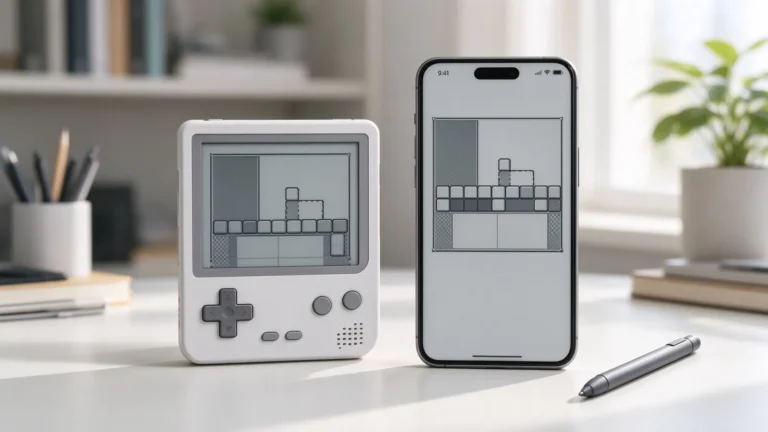
The practical observation is simple. If you want to understand why the link cable mattered, load a personal backup of Tetris and play two linked windows side by side. The garbage lines will make sense in seconds. The part that is harder to recreate is the person sitting next to you.