The History of Handheld Gaming: From Game Boy to PSP
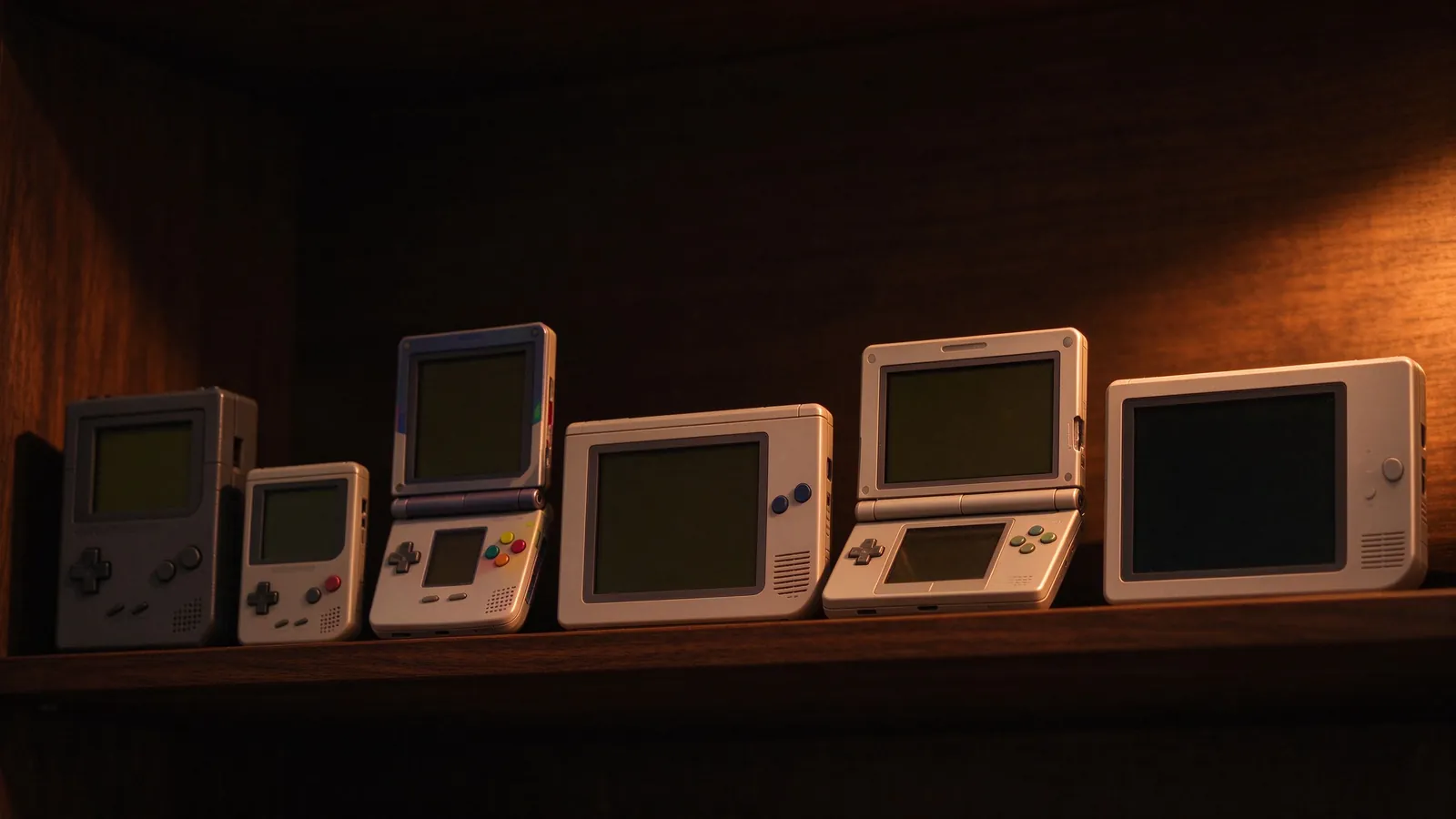
A handheld console history tracing portable gaming from Nintendo’s 1989 dot-matrix Game Boy through color screens, the GBA leap, the touch DS and Sony’s disc-based PSP.
Handheld console history begins with the idea that a game should fit in a coat pocket and run on batteries for hours. Before dedicated cartridges, Nintendo sold tabletop LCD units in the early 1980s, each one a single fixed game; the real generational shift arrived in 1989, when two colorless ideas competed for living-room shelves and commuter bags. The decades since have moved from four shades of gray to backlit color, touch controls, discs and online play, and modern emulators now let players replay most of that library on a phone or laptop.
1989: the Game Boy and the color competition
Nintendo released the Game Boy in Japan in April 1989 and in North America that July, pairing a chunky gray body, a four-shade dot-matrix screen and long battery life with Tetris, a puzzle game that turned the device into a social object on school buses and office breaks. The contrast rivals arrived almost immediately: the Atari Lynx launched later in 1989 with a color backlit screen but short battery life, and Sega’s Game Gear followed in 1991 with color and a TV tuner accessory. Better graphics did not win sales; battery endurance, a strong game library and lower cost did, and Nintendo kept the original Game Boy design refined through the smaller Game Boy Pocket in 1996.
Sega’s later Genesis Nomad in 1995 could play home console cartridges on the road, but it was heavy, expensive and short-lived, which showed that portable hardware needed its own game lineup rather than a home system bolted into a shell.
Color arrives: Game Boy Color and the GBA leap
The Game Boy Color launched in 1998 with a small color screen and full backwards compatibility with older cartridges, extending the library rather than replacing it. The bigger jump came in 2001 with the Game Boy Advance: a 32-bit horizontal handheld with a wider landscape screen, capable of ports from SNES and early arcade classics, plus original games built around shoulder buttons and fast-paced action. The 2003 Game Boy Advance SP added a clamshell fold, a rechargeable battery and a lit screen, solving two common complaints of launch hardware, while later iterations shrank the form factor further. This era built the deepest portable library of the early 2000s; our list of best GBA games, classics and hidden gems catalogs the titles worth revisiting.
Touch and discs: Nintendo DS and Sony PSP
By late 2004 the handheld split into two philosophies. The Nintendo DS launched in North America in November 2004 and Japan in December, with two stacked screens, a stylus touch input, a microphone and backwards compatibility for Game Boy Advance carts. It aimed at casual players, brain-training software and strange experiment ideas alongside traditional role-playing games, and our feature on classic Nintendo DS games samples that catalog.
Sony’s PlayStation Portable arrived in Japan that December and in North America in March 2005, choosing the opposite path: a wide screen, an optical disc format called UMD for movies and games, Wi-Fi multiplayer and multimedia playback. It sat closer to a portable console than a toy-like device, and its action libraries fit long commutes; browse our picks for best PSP games for a commute and set them up through PPSSPP emulator on PC or phone if original hardware feels hard to source.
Where the lineage leads today
After the DS and PSP, dedicated handhelds overlapped with smartphones, subscription classics libraries and hybrid consoles that dock to a television. Yet the older generations still matter: emulation preserves titles that were never remastered, community speedruns keep speed-sensitive classics alive, and cartridge collecting makes physical history playable again. The through-line from 1989 to today is simple: designers kept shrinking the hardware while expanding the kinds of games it could hold, and players still carry favorites on the commuter train.